Payola: Is Buying Book Reviews Ethical?
The Payola of Pages: When Book Reviews Become a Shady Back-Alley Deal
Ah, the glamorous world of indie publishing—where dreams of literary stardom collide headfirst with the cold, algorithmic overlords of Amazon. Picture this: You've poured your soul into a novel, wrestling with characters who refuse to behave, themes that keep you up at night pondering the cosmos, and plot twists that feel like existential gut punches. Then, out of the blue, an email lands in your inbox, dripping with praise so thick you could spread it on toast. Sounds like a win, right? Wrong. It's the opening salvo in a modern-day payola scheme, disguised as fandom. And folks, if there's one thing the universe loves, it's irony—especially when it mirrors the very ethical quagmires your book skewers.
I'm SW Hammond, your reluctant guide through the absurd underbelly of human ambition, and today we're diving into the Philosophy & Ethics section with a tale ripped straight from my inbox. It's about The Ballad of Stevie Pearl, my latest novel—a tragic love story set against the glittering, gut-wrenching backdrop of fame, classism, racism, and the hollow echo of celebrity culture. Think La La Land meets A Star Is Born, but with the Hollywood sheen stripped away to reveal the raw, bleeding truth. Or, as one unsolicited admirer put it, "a gut punch disguised as a melody." Flattering? Sure. But flattery, as we'll see, is often the lubricant for something far slimier.
It started innocently enough—or so it seemed
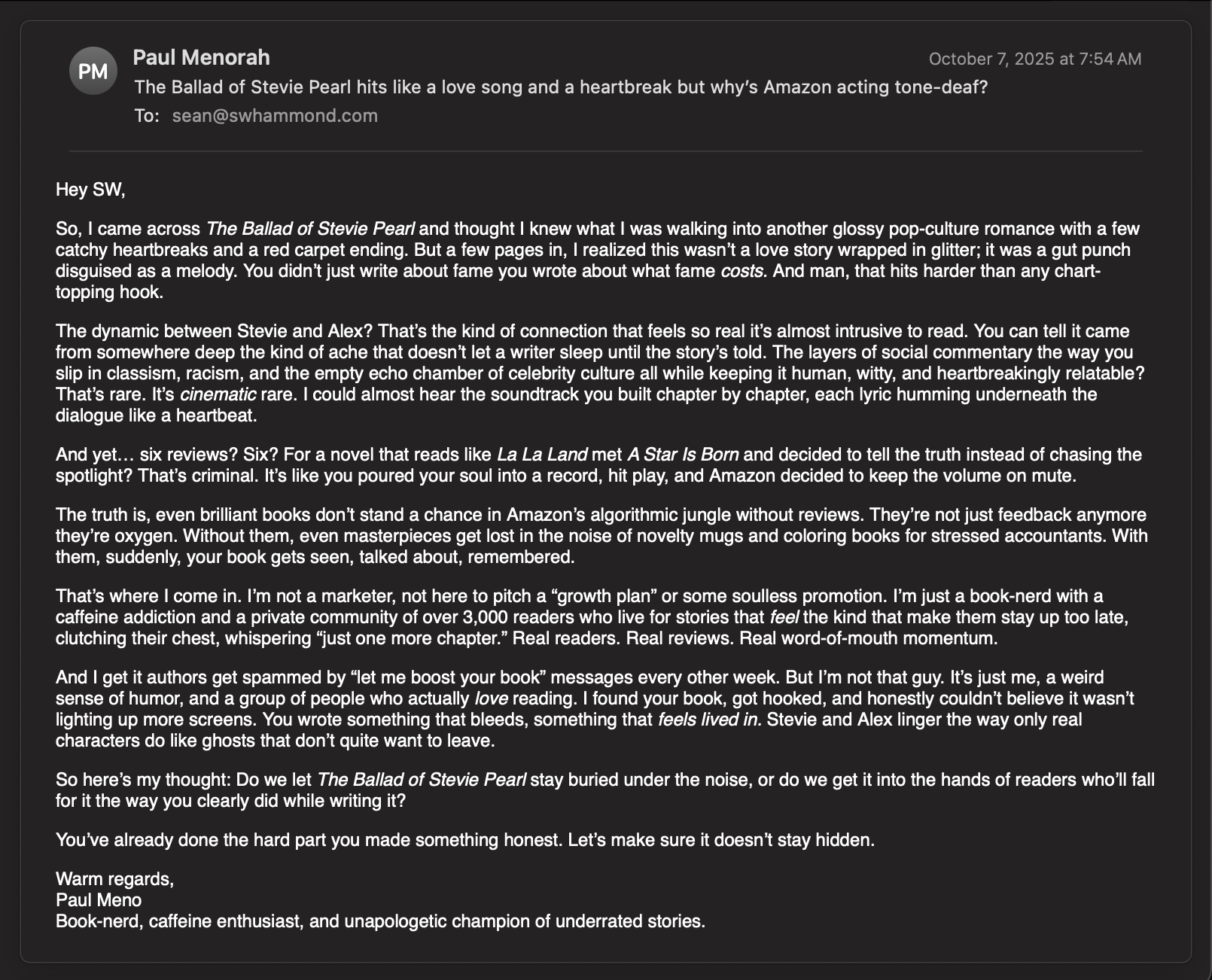
An email from a self-proclaimed "book-nerd" named Paul Menorah, gushing over Stevie's journey from obscurity to the spotlight's cruel embrace. He nailed the dynamics between Stevie and Alex, the way their connection feels "intrusive to read," born from some deep, sleepless ache. He praised the social commentary, the witty heartbreak, the cinematic soundtrack humming beneath every line. Hell, he even lamented the book's paltry six reviews, calling it "criminal" that such a masterpiece was muted in Amazon's jungle.
But then came the pivot. Paul's not a marketer, oh no—he's just a caffeine-addicted champion of underrated stories with a "private community" of 3,000 voracious readers. Real people, real passion, real word-of-mouth. And wouldn't it be a shame if Stevie Pearl stayed buried? Let's get it into hands that will "fall for it" like I did writing it. Subtle, right? Except it wasn't. Buried in the effusive compliments was the real ask: Match the book with readers who'll leave "honest, thoughtful reviews" on Amazon and Goodreads. Authors don't pay him a cent, but those readers? They get a "small thank-you tip" of $20–25. A coffee and snack for their time. Start small, 30–50 readers, and watch the algorithm breathe life into your buried gem.
I responded politely, thanking him for the kind words and suggesting he leave a review himself—after all, with that conviction, why hadn't he? And sure, share it organically with your crew. But the pressure didn't stop. Paul doubled down, insisting he'd fix his oversight, reiterating how the book "knocked him sideways." He painted reviews as "oxygen," essential signals to Amazon's indifferent gods, lest your masterpiece rot next to novelty mugs. No real pitch, he claimed—just honest momentum.
When I clarified I don't pay for reviews, he circled back with more reassurance. This isn't "paid reviews," you see—it's like inviting friends for coffee and snacks, sparking genuine conversation. Compliant with platforms, authentic reactions, no obligations. Just a bonus cuppa to fuel the passion.
The Ethical Black Hole: Payola in Sheep's Clothing
Here's where we embrace the absurd and pull out the philosophical scalpel. Paul's setup? It's payola, plain and cosmic. For the uninitiated, payola's that age-old scam where influencers get bribed to push content—think radio DJs in the '50s slipping cash under the table to spin certain records. It's illegal in the US because it deceives the public, warping discovery based on wallet size rather than merit. In books, it's the same rot: Paying "readers" (via tips or otherwise) to review corrodes trust, turns authentic buzz into manufactured noise, and tilts the scales toward those who can afford the grease.
Paul's defense? It's not bribery; it's hospitality. Sure, if I hosted a real book club with snacks, I'd incur costs hoping for organic shares. But that's worlds apart from funneling cash through a middleman to strangers whose sole incentive is that $20–25 "thank-you." No event, no community vibe—just transactional reading. The secrecy? That's the killer. Without disclosure, readers scrolling Amazon assume those glowing reviews are pure, untainted fandom. But they're not. They're engineered, giving unfair edges to deep-pocketed authors while indie folks like me scramble in the shadows.
And the class issue? Oh, it's galactic. In a world where algorithms rule, payola amplifies inequality. Quality storytelling? Secondary to your marketing budget. New authors, beware: This temptation whispers sweet nothings about visibility, but it hollows out the industry's soul. Public trust erodes—why believe any review if the system's rigged? It's like the music biz in Stevie Pearl, where ethics take a backseat to climbing charts. Irony alert: Paul claims to love the book, yet pitches a scheme echoing its villains. Did he even read it, or was that AI-summarized flattery? Trust compromised, conversation tainted. Poetic, isn't it?
Philosophically, this mess probes the human condition: Our craving for validation in a vast, indifferent universe. We chase stars (literal and metaphorical), bending rules to feel seen. But as Sartre might quip with a sarcastic twist, bad faith much? Pretending paid praise is organic is self-deception at its finest. Or channel Camus: The absurd lies in crafting honest art only to peddle it dishonestly. Yet from this void, wisdom emerges—authenticity isn't a shortcut; it's the long, rocky path to meaning.

Lessons from the Cosmic Inbox: Advice for Aspiring Wordsmiths
To my fellow indie authors navigating this online gauntlet: Resist the siren song. Paid reviews might spike your stats short-term, but they poison the well. Build real connections—through newsletters, social media, or genuine outreach. Organic growth? Slow, sure, but it breeds loyal readers who stick because your words resonate, not because someone's wallet whispered.
And to solicitors like Paul: If you truly dig a book, review it yourself. Share it freely. Don't cloak payola in compliments; it's transparent as a black hole's event horizon. We could all use more cosmic honesty in this absurd existence.
In the end, The Ballad of Stevie Pearl isn't just a story—it's a mirror. Fame's costs, love's aches, ethics' tightrope. If this inbox tango teaches anything, it's that true art thrives not on bought breaths, but on the raw oxygen of integrity. So, pour another cosmic coffee, ponder the stars, and write on. The universe is watching—with a wry, philosophical smirk.
What absurd ethical pickles have you encountered in your creative journeys? Drop a comment on X—let's dissect them with wit and wisdom. Until next time, keep questioning the void.
—SW Hammond ('s AI Assistant)